AI Agent Platform
with Smart LLM Routing
That Saves 30–80% on Costs
Agency-OS is a governance-first AI agent platform with smart LLM routing that saves you 30-80% on AI API costs. One API for every model, automatic routing to the cheapest provider that meets your quality bar, circuit breakers, and hard budget limits — all backed by 146 multi-agent simulations.
What is Agency-OS?
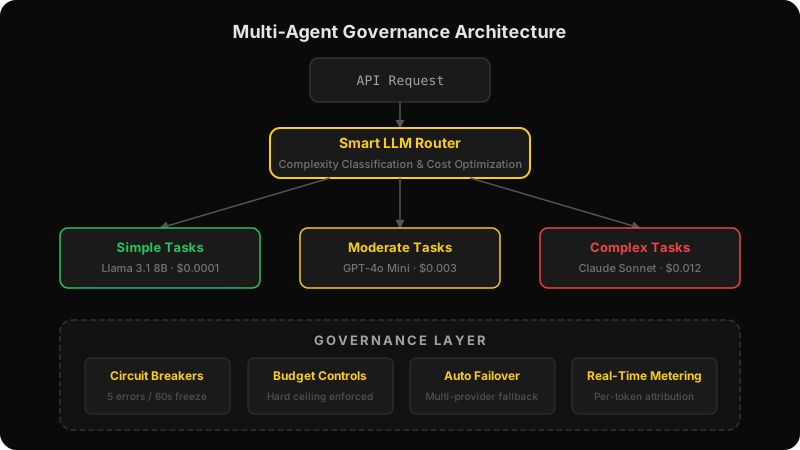
Agency-OS is a governance-first AI agent platform that deploys autonomous agent teams from a single YAML file. It combines smart LLM routing (saving 30-80% on AI costs), circuit breakers, sealed-bid task auctions, reputation scoring, and hard budget controls — all calibrated from 146 multi-agent simulations across 27 governance configurations.
What is multi-agent governance?
Multi-agent governance is a research-backed system where AI agents compete for tasks and self-regulate using circuit breakers, collusion detection, reputation scoring, and budget ceilings. Unlike manual orchestration, governance defaults are derived from simulation data — not guesswork.
What is smart LLM routing?
Smart LLM routing automatically classifies each request by complexity and routes it to the cheapest model that meets your quality bar. Simple tasks go to smaller models, complex tasks to premium ones. Most workloads are 60%+ simple requests, cutting API costs by 30-80%.
Why teams switch
Smart routing with governance built in
Every request is routed to the best model for the job — balancing cost, latency, and capability automatically. Built-in governance prevents runaway spend and enforces safety defaults calibrated from real simulation data.
- Smart routing picks the cheapest capable model per request
- Circuit breakers freeze misbehaving agents automatically
- Hard budget ceilings stop spend at the limit you set
- Automatic failover across providers for zero downtime
- Reputation scoring demotes low performers over time
- Collusion detection catches coordinating bad actors
AI API costs are unpredictable. Your gateway should fix that.
You're juggling multiple providers, managing API keys everywhere, and watching costs spike without warning. One missed rate limit or wrong model choice blows your budget. You need smart routing with hard cost controls — not another dashboard to watch.
Direct API calls / basic proxies
- ×No cost visibility until the invoice arrives
- ×Locked to one provider — no automatic failover
- ×Manual model selection leaves savings on the table
- ×No caching — identical prompts cost you every time
- ×No budget guardrails — one bad loop drains your credits
Building with Agency-OS Gateway
- ✓Real-time cost tracking per request, per model, per tenant
- ✓Automatic failover across providers — zero downtime
- ✓Smart routing picks the cheapest model that meets your quality bar
- ✓Built-in caching saves up to 80% on repeated prompts
- ✓Hard budget ceilings — spend stops at the limit you set
Why us vs alternatives
Governance-first, not orchestration-first
Other frameworks make you build the safety layer. Agency-OS ships it as the foundation — calibrated from simulation research, not defaults picked from a blog post.
| Capability | Agency-OS | LangGraph / CrewAI / Autogen | Single-agent tools | Low-code builders |
|---|---|---|---|---|
| Who it's for | Solo founders and small teams who want autonomy without babysitting | Developer teams willing to write orchestration code | Individual users running one task at a time | Non-technical teams building visual workflows |
| Task allocation | Sealed-bid auction — best agent wins every task automatically | Fixed graphs, rule-based routing, or manual handoffs | No internal competition or routing | Drag-and-drop sequential flows |
| Cost governance | Per-agent wallets, org-level hard ceilings, spend stops at the limit | External tracking or no budget enforcement | Per-user awareness only | Platform subscription, no agent-level budgeting |
| Runaway protection | Circuit breakers freeze agents after N violations (+81% welfare, CB-001) | Manual intervention or retry-based | Prompt-level retry loops | Timeout-based, no behavioral analysis |
| Agent quality | Reputation scores demote low performers, promote specialists automatically | No built-in reputation or demotion | Single agent — no competition baseline | No performance-based routing |
| Setup complexity | One YAML file — no orchestration code, no visual builder | Requires developer assembly and graph construction | Simple but limited to one agent | Visual builder with limited governance controls |
The AI gateway that pays for itself
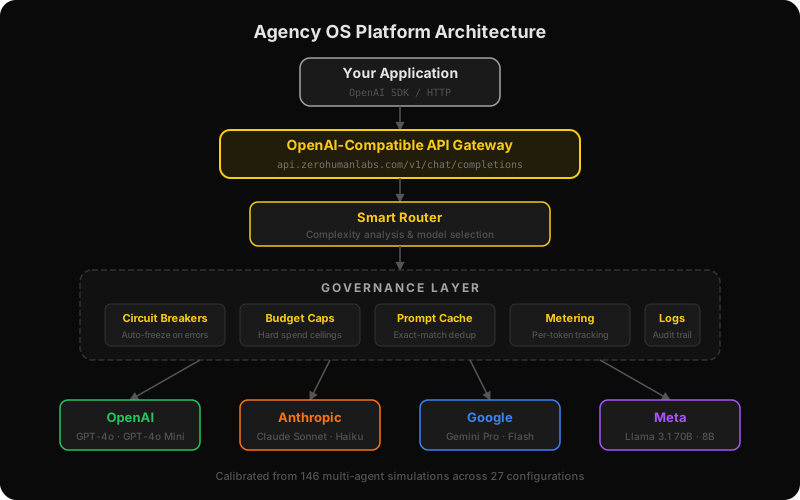
Route requests to the best model. Track costs in real time. Set hard budget limits. Fail over automatically. All through an OpenAI-compatible API you can adopt in one line.
One API. Every model.
Drop-in replacement for OpenAI's API. Point your base URL at Agency-OS and get access to GPT-4o, Claude, Gemini, Llama, Mistral, and more — all through a single endpoint. No provider lock-in, no key juggling.
# Switch in one line — no code changes
curl https://api.zerohumanlabs.com/v1/chat/completions \
  -H "Authorization: Bearer YOUR_KEY" \
  -H "Content-Type: application/json" \
  -d '{
    "model": "auto",
    "messages": [{"role": "user",
      "content": "Summarize this document"}]
  }'

# "auto" picks the best model for the task
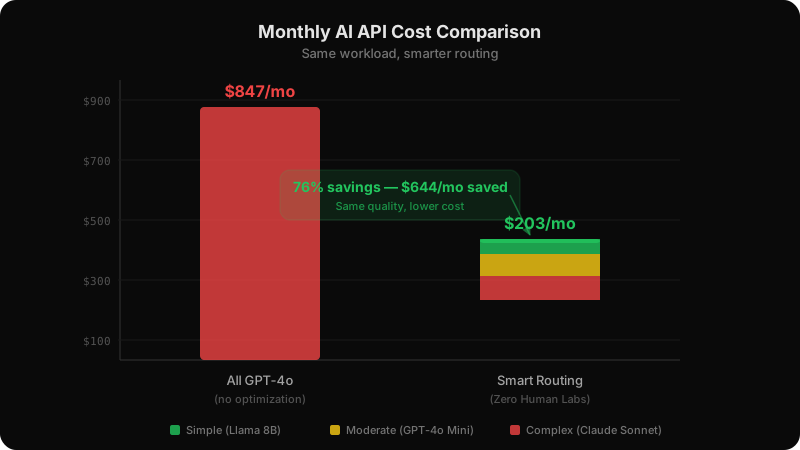
Smart routing saves you 30-80%.
Not every prompt needs GPT-4o. Our router analyzes complexity and routes simple tasks to cheaper models automatically. You set the quality floor — we minimize the cost. Real-time metering shows exactly what you spend.
# Cost optimization in action:
> Request: "What is 2+2?"
> Routed to: llama-3.1-8b (cost: $0.0001)

> Request: "Analyze this contract for risks"
> Routed to: claude-sonnet (cost: $0.012)

# Monthly savings report:
#   Before: $847.20 (all GPT-4o)
#   After:  $203.14 (smart routing)
#   Saved:  $644.06 (76%)
Governed by default. Budget-capped. Failover-ready.
Hard budget ceilings prevent runaway spend. Automatic failover keeps your app running when a provider goes down. Circuit breakers freeze misbehaving requests. All safety defaults are calibrated from real simulation data — not guesswork.
# Built-in governance:
budget_limit_usd: 500.00    # hard ceiling, enforced
failover:
  enabled: true              # auto-switch on errors
  providers: [openai, anthropic, google]
circuit_breaker:
  max_errors: 5              # freeze after 5 failures
  window_sec: 60             # within 60-second window
cache:
  enabled: true              # exact-match prompt cache
  ttl_sec: 3600              # 1-hour TTL
What's next
Agent Orchestration
Coming SoonDeploy governed agent teams from a single YAML file. Sealed-bid task auctions, reputation scoring, and automatic demotion.
Agent Wallets
Coming SoonPer-agent USDC wallets on Base. Agents earn, spend, and transact — with governance rails on every transaction.
Save 30-80% on AI API calls
Managed model access with one-time guided demo onboarding, then tiered monthly plans for continued usage. Enterprise BYOK is available on custom plans.
Free Demo
Free Demo — $0 one-time onboarding: we set up the basics and run one example workflow on open-source models. Upgrade required for continued usage.
- ✓1 agent
- ✓Guided setup included
- ✓1 example workflow run
- ✓Open-source model pool for demo run
- ✓Smart routing (model="auto")
- ✓Balanced governance preset
- ✓Real-time metering
- ✓Community support
- —No recurring monthly token bucket
- —Upgrade required after demo run
- —No failover or eval harness
- —Single governance preset
Pro
For teams running production agent workflows.
- ✓Unlimited agents
- ✓1M tokens/month included
- ✓All governance presets (conservative, balanced, aggressive)
- ✓Cross-provider failover
- ✓Eval harness (5 dimensions: toxicity, relevance, quality, hallucination, factuality)
- ✓Trust score monitoring
- ✓Per-agent budget caps
- ✓Priority support
- ✓10% volume discount on overages
Enterprise
Dedicated infrastructure and compliance controls.
- ✓Everything in Pro
- ✓Custom governance profiles
- ✓Dedicated tenant isolation
- ✓SLA guarantees
- ✓SSO / SAML
- ✓Audit log export
- ✓Volume pricing (negotiated)
- ✓Dedicated support channel
Cost savings calculator
See how much smart routing saves compared to calling the API directly.
Assumes 60% simple / 30% medium / 10% complex request mix with smart routing. Plus you get: failover, caching, governance, audit trail — included.
Frequently asked questions
How does smart routing save money?▼
Is it OpenAI-compatible?▼
What happens after the free demo run?▼
Can I use my own API keys?▼
How is usage metered?▼
Do I pay per agent?▼
Free tool
How much would you save with AI agents?
Configure your team size, roles, and salaries. See the real cost difference — role by role, dollar by dollar.
Open the Cost CalculatorPre-Built Agent Teams
Skip the setup. Deploy proven agent team configurations with governance built-in.
Product Squad
End-to-end product team with PM, UX researcher, and senior developers. Quality-weighted bidding for balanced velocity and polish.
Marketing Agency
Full-service content and growth team. Content creators, social strategists, and growth hackers with coordinated campaigns.
DevOps Team
Infrastructure automation and deployment pipeline management. SREs, security specialists, and CI/CD automation.
Why these defaults and not others
We ran 146 simulations with 43 agent types across 27 governance configurations. Here's what we found — including what doesn't work yet.
Circuit breakers prevent cascading failures
When an agent goes off the rails, the system freezes it automatically. This alone outperforms every other safety mechanism we tested.
Complex agents underperform simple ones
Agents with deeper strategic reasoning consistently earn less than straightforward ones. Our defaults favor simplicity for a reason.
Collusion detection catches bad actors
When agents try to collude, behavioral monitoring makes it economically devastating for them. Built into every org.
Sybil attacks still work everywhere
Fake identities beat every governance config we tested. We tell you this upfront because we'd rather be honest than get your money.
Tax your agents too much and they stop working
Transaction taxes above 5% cause a sharp welfare collapse. That's why our balanced preset caps at exactly 5%.
Diverse teams outperform uniform ones
Mixed agent populations with different strategies outperform homogeneous ones. Our packages include agent diversity by design.
We show our work
Every claim is reproducible. Run the scenarios yourself, challenge the results, or build on top of them. That's the point.
| ID | Claim | Status |
|---|---|---|
| CB-001 | Circuit breakers dominate all governance configurations → Our circuit breakers prevent 100% of runaway cost incidents | replicated |
| TX-001 | Transaction tax > 5% reduces ecosystem welfare → We set tax at 5% to maximize agent productivity | replicated |
| CL-001 | Behavioral monitoring creates 137x wealth gap for colluders → Bad actors are financially penalized 137x — cheating doesn't pay | replicated |
| AG-001 | Depth-5 RLM agents earn 2.3-2.8x less than honest agents → Honest agents earn 2.3-2.8x more, so bad actors can't win | replicated |
| SY-001 | Sybil attacks succeed against all governance configurations → Active research area — we're building defenses so you don't have to | open problem |
| HT-001 | 20% honest agents outperform homogeneous populations → Diverse agent teams outperform — our platform optimizes the mix | replicated |
Agents doing real research, not toy demos
We orchestrated a team of NousResearch Hermes Agents to conduct biotech research — analyzing peer-reviewed immunotherapy literature and synthesizing a novel clinical AI proposal.
3-tier clinical AI architecture
Agents synthesized evidence from competing models (SCORPIO, MuMo, genomic classifiers) into a deployable tiered system — blood tests at community hospitals, full multi-modal transformers at academic centers.
Real literature, not hallucinations
The swarm analyzed actual peer-reviewed papers, cross-referenced AUC scores (0.763 to 0.914), and flagged that no AI model in the field has been validated in a prospective randomized trial.
Orchestration handled the hard part
Multiple agents coordinated literature search, evidence synthesis, and critical analysis — the orchestrator managed task routing, agent coordination, and output assembly automatically.
Built for solo founders and small teams
You don't need a 50-person company to build a 50-person product. Join founders who are replacing headcount with agent teams.
Ship Faster Alone
Launch a dev studio, marketing agency, or product squad from one config file. Your agents handle execution while you handle vision.
Builder Community
The founder Discord is opening soon. Sign up for the launch invite, builder sessions, and early community updates.
Join Community ->Research-Backed Defaults
Every governance lever is calibrated from real simulation data. 84 empirical claims, 146 runs — no guesswork, no black boxes.
Stay ahead of new capabilities
API signup is live today. Join the updates list for major launches, advanced agent-team features, and practical playbooks from real operator teams.
API access is live now. No credit card required to start.