Demo: Geopolitical Swarm Simulation Meets Live Market Data
Demo: Modeling a Geopolitical Ecosystem With Live Market Data
We ran an experiment: model the full ecosystem of actors in the Iran crisis — military commanders, diaspora organizers, oil traders, OPEC delegates, Western policymakers — and watch how their non-market priorities cascade into market outcomes.
We combined real-time crisis data from Iran Monitor with live perpetual futures prices from Hyperliquid, and fed both into MiroFish — a multi-agent swarm intelligence engine. The result: 21 actors with distinct identities, priorities, and information diets, interacting on a simulated Twitter.
The insight isn't "AI predicts oil prices." It's that actors who don't care about oil prices — whose priorities are territorial control, sanctions circumvention, wealth preservation, protest coordination — produce market consequences that pure price analysis misses.
The Setup
Seed Data
We built a combined intelligence document with two data sources:
Iran Monitor — a real-time crisis monitoring platform tracking protests, sanctions, diplomacy, conflict, internet shutdowns, and economic indicators inside Iran. Events are scored by confidence level and impact severity.
Hyperliquid DEX — live perpetual futures prices as of March 28, 2026:
| Asset | Price | Source |
|---|---|---|
| BTC | $66,162 | Perp |
| ETH | $1,987 | Perp |
| PAXG (Gold) | $4,493 | Perp |
| WTI Crude | $99.90 | xyz:CL |
| Brent Crude | $107.41 | xyz:BRENTOIL |
| Gold | $4,495.55 | xyz:GOLD |
| Natural Gas | $3.04 | xyz:NATGAS |
Knowledge Graph
MiroFish extracted entities and relationships from the seed document using LLM-based entity extraction, stored in a local NetworkX graph (no external dependencies):
- 21 entities across 10 types: OilTrader, CryptoSpeculator, InstitutionalInvestor, IRGCActor, WesternPolicyMaker, OPECMember, MarketMaker, IranianCitizen, Organization, Commodity
- 11 relationships: INFLUENCES, TRADES, SUPPLIES, PARTICIPATES_IN, PROVIDES_LIQUIDITY
Key relationships the graph captured:
- Tehran Government → INFLUENCES → OPEC production decisions
- Western Coalition → INFLUENCES → Tehran Government policy
- Iran → SUPPLIES → IRGC (Strait of Hormuz control)
- Chinese/Russian Buyers → TRADES → OPEC Members (discounted oil)
Agent Profiles
Each graph entity became a simulated Twitter agent with a distinct persona, bio, and behavioral tendencies. We ran multiple simulations — varying agent counts (10–20), rounds (3–5), and LLM backends (OpenRouter GPT-4o-mini, local Ollama qwen2.5) — to stress-test how different agent configurations produce different market narratives.
What the Actors Said
The key finding isn't what any single actor predicted. It's how actors with fundamentally different priorities — survival, sovereignty, profit, stability — independently produced a coherent picture of how this crisis transmits to markets.
Non-Market Actors Producing Market Consequences
IRGC — priorities: territorial control, sanctions circumvention
"Recent protests in Iran have escalated, leading to fears of a general strike. The ensuing economic disruptions could significantly influence oil supply and gold demand."
The IRGC agent didn't reason about oil prices. It reasoned about protest suppression and supply chain control. The oil price impact is a consequence of those priorities — exactly the kind of second-order effect that pure market analysis misses.
Tehran Government — priorities: regime stability, diplomatic leverage
"The Iranian government has indicated a willingness to negotiate nuclear terms, but the uncertainty surrounding this could lead to fluctuating oil risk premiums. OPEC members must consider their production responses carefully."
The government agent framed nuclear negotiations as a diplomatic tool, not a market signal. But the market implication — oil risk premium fluctuation — cascades directly from that non-financial priority.
Iranian Diaspora — priorities: human rights, wealth preservation, protest coordination
"Crypto adoption among Iranian citizens may rise as a means of preserving wealth."
This was the most striking output. No trader agent mentioned crypto-as-survival. It took an actor with ground-level priorities — people trying to preserve their savings under a collapsing rial — to surface a dynamic that pure market models don't capture. This is a documented, real phenomenon in Iran.
Market Actors Receiving the Cascade
Oil Traders — received: supply disruption signals from IRGC + Tehran priorities
"Historical data indicates that such escalations can add a $5-15/barrel risk premium. Traders should prepare for volatility." "Recent military maneuvers in the Strait of Hormuz raise alarms about potential disruptions in global oil transit."
The oil traders quantified what the IRGC agent's territorial priorities imply for supply — $5-15/barrel risk premium, Strait chokepoint disruption. They connected the dots, but the dots originated from actors who weren't thinking about markets at all.
Institutional Investors — received: safe-haven flow signals from rial collapse + sanctions pressure
"With the Iranian rial facing immense pressure due to ongoing economic turmoil, we see an increased flight to gold as a stable asset." "Central banks, including Iran's own, have been buying large amounts of gold in response to the expanding sanctions regime."
Gold wasn't just a trade here. It was the institutional response to a cascade that started with sanctions policy (Western Coalition), ran through currency collapse (Iranian citizens), and surfaced as central bank survival strategy.
Crypto Speculators — received: narrative signals from internet shutdowns + diaspora activity
"The crypto market may face turbulence as the Iranian internet shutdown narrative unfolds."
The crypto agent reacted to the narrative of internet shutdowns — but that narrative originates from a government suppression tactic aimed at protest coordination, not at crypto markets. The market impact is entirely a side effect.
Information Layer
Iran Monitor & Journalists — synthesized the connections
"Iranian sanctions continue to tighten, with the Strait of Hormuz becoming a critical chokepoint for global oil supplies." "The Iranian Diaspora is coordinating protests against the sanctions, with reports of increasing internet shutdowns in key cities."
The information agents connected physical infrastructure (Strait chokepoint), human activity (diaspora protest coordination), and policy mechanisms (sanctions enforcement). They bridged the non-market actors and the market actors.
Simulation Results
Across 7 simulation runs (varying agent counts, rounds, and LLM backends), the agents produced 192 posts and 778 total actions.
Agent Action Distribution
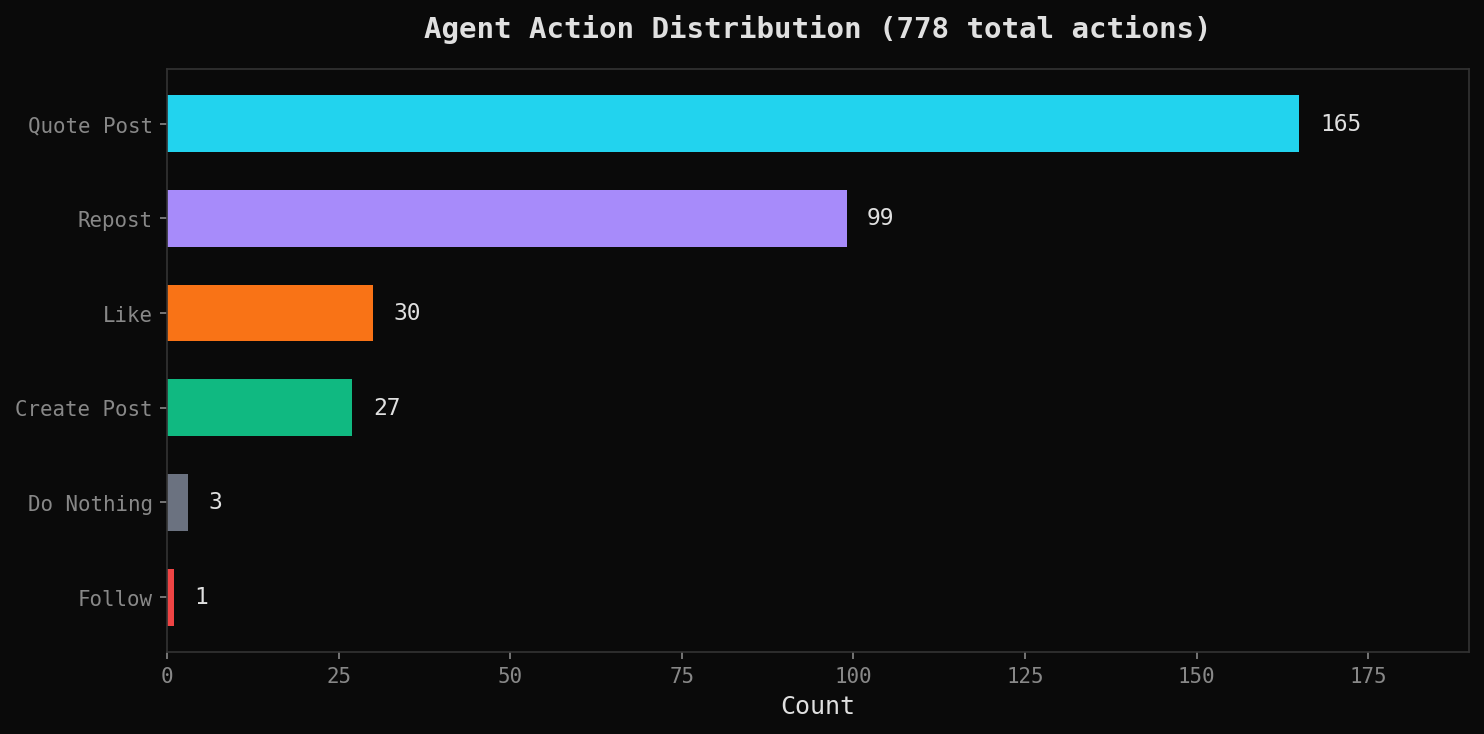
Quote posts dominated (165) — agents didn't just broadcast, they engaged with each other's takes and added their own framing. Reposts (99) show information cascading through the network. Only 27 original posts, but each sparked chains of engagement.
Topic Distribution
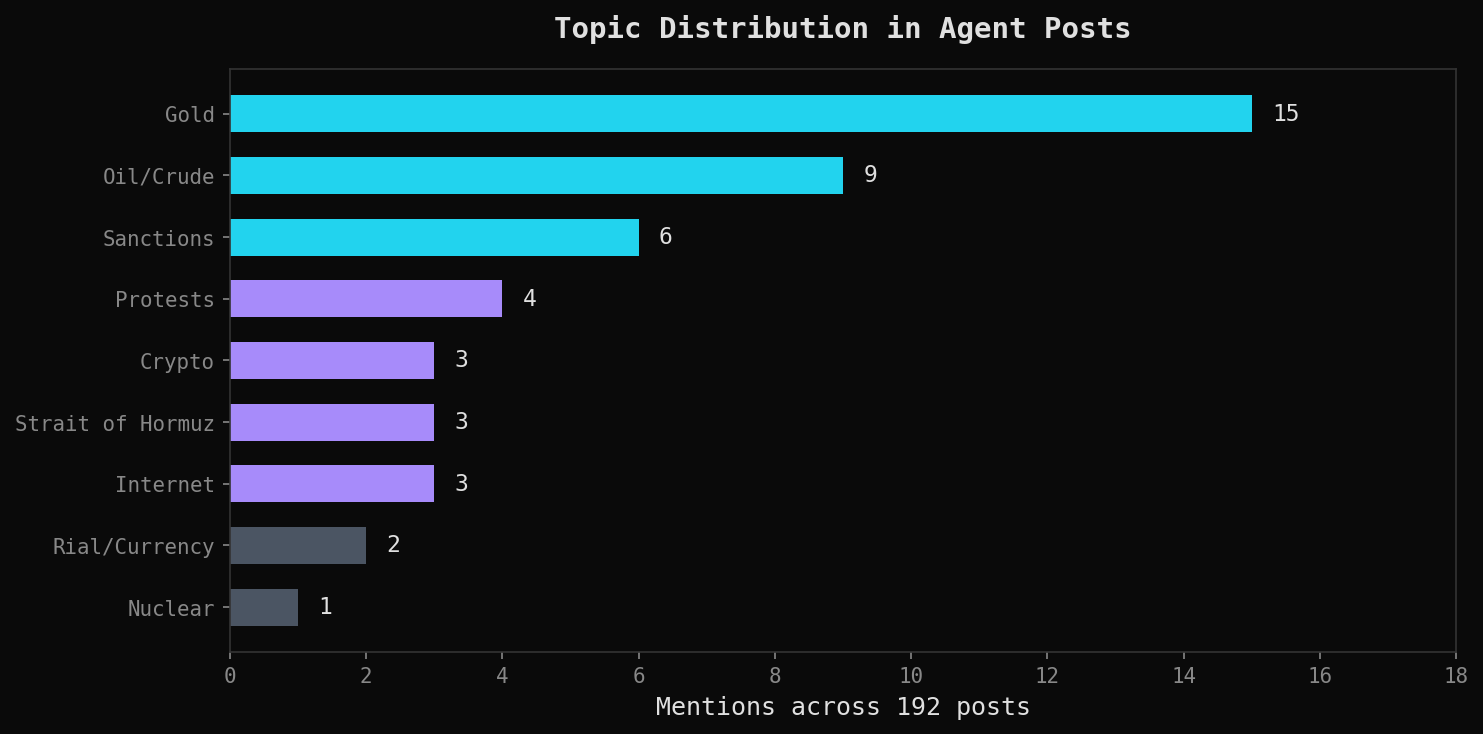
Gold dominated agent discussion (15 mentions), followed by oil/crude (9) and sanctions (6). This mirrors real market behavior: in a Middle East crisis, gold is the first safe-haven trade, oil is the direct supply play, and sanctions are the policy mechanism that connects geopolitics to prices.
Narrative Flow: Events to Markets
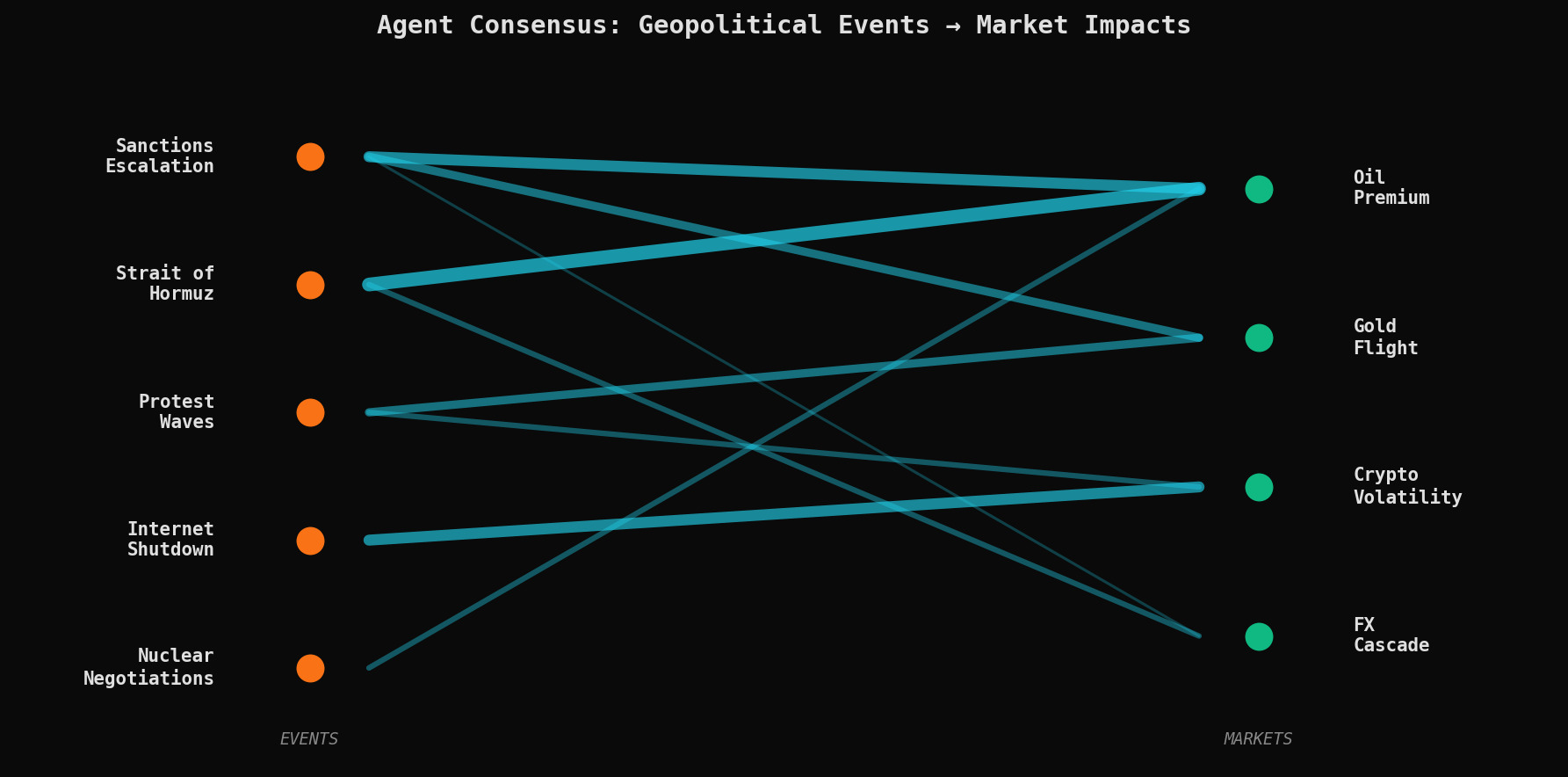
This maps how agents connected geopolitical events to market outcomes. Line thickness reflects strength of agent consensus. Sanctions escalation routes to both oil premium and gold flight. The Strait of Hormuz is the strongest single-event driver of oil price impact. Internet shutdowns route almost exclusively to crypto volatility — agents correctly identified this as a narrative-driven trade.
Agent Focus Profiles
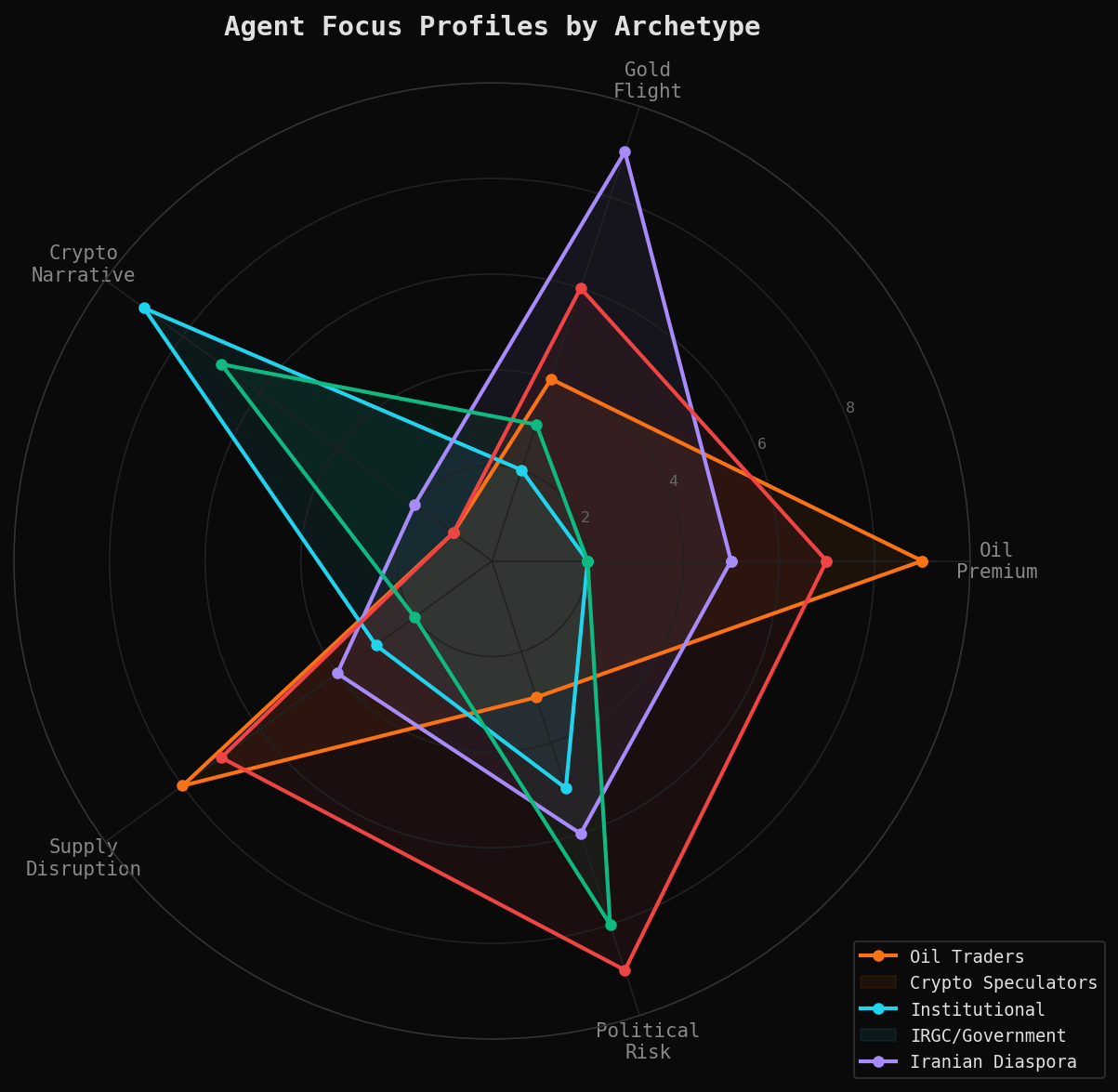
Each agent archetype has a distinct focus profile. Oil traders spike on oil premium and supply disruption. Crypto speculators spike on crypto narrative. Institutional investors spike on gold flight. IRGC/Government agents have the broadest profile — they see political risk, supply disruption, and oil premium simultaneously. The Iranian diaspora uniquely combines crypto narrative with political risk — reflecting their real-world position as both protest coordinators and crypto adopters.
What This Demonstrates
1. Non-market actors produce market outcomes
The most important outputs didn't come from market agents. They came from actors whose priorities are territorial control, regime stability, and personal survival. Modeling only market participants misses the origin of the signals those participants react to.
2. Ecosystem simulation preserves causal structure
A standard market model collapses "Iran crisis" into a single risk factor. The swarm simulation preserved the causal chain: IRGC territorial priorities → Strait disruption risk → oil supply uncertainty → trader risk premium. Each link has its own actors, its own logic, and its own failure modes.
3. Real market data grounds abstract reasoning
Starting from actual Hyperliquid prices ($99.90 WTI, $4,495 gold, $66K BTC) meant agents reasoned about concrete levels, not abstractions. The oil trader's "$5-15/barrel risk premium" maps directly to a $105-115 WTI target — a specific, falsifiable claim derived from ecosystem dynamics.
4. Survival dynamics surface from the right actors
The diaspora agent's crypto-as-survival insight didn't come from modeling crypto markets. It came from modeling people under currency collapse. Market analysis asks "will crypto go up?" Ecosystem analysis asks "who needs crypto to survive, and why?" — and the market implications follow.
Technical Stack
| Component | Role |
|---|---|
| Iran Monitor | Real-time geopolitical crisis data |
| Hyperliquid DEX | Live perp and commodity futures prices |
| Agency-OS Market Data API | x402-gated risk scores (feeds Hyperliquid data) |
| MiroFish + NetworkX | Swarm simulation engine with local graph backend |
| GPT-4o-mini / qwen2.5:7b | Agent decision-making (cloud or local Ollama) |
| OASIS | Twitter platform simulation engine |
Runs Anywhere — No Cloud Dependencies
We built a NetworkX adapter that replaces MiroFish's default Zep Cloud dependency for knowledge graph storage. The entire pipeline — entity extraction, graph construction, entity reading, profile generation — runs locally with zero external dependencies.
We tested across multiple LLM backends:
- GPT-4o-mini via OpenRouter — best output quality, but rate-limited for multi-agent workloads
- qwen2.5:7b via local Ollama — fully local, no API costs, good structured output
- qwen2.5:14b via local Ollama — best local quality, but high memory requirements
The simulation produces meaningful results regardless of backend — the agent archetypes and market reasoning hold across model sizes.
A Note on Framing
We're careful about this: geopolitical simulation isn't about reducing human crises to trading signals. People in Iran are facing real consequences — currency collapse, internet shutdowns, political violence. Those aren't "market events."
The point of ecosystem simulation is the opposite of reductive: it models actors as having their own priorities, not as inputs to a price model. The IRGC agent cares about territorial control. The diaspora agent cares about survival. The market consequences are downstream of those human realities, not the other way around.
What's Next
The Market Data API that served the Hyperliquid prices is live as an x402-gated service. Other agents can query risk scores and pay per call in USDC on Base — no API key, no signup.
Endpoint docs: zero-human-labs.com/market-data
The simulation demonstrates what happens when you model the full ecosystem of actors in a crisis, rather than just the market participants. Non-market priorities — sovereignty, survival, protest — produce the signals that markets react to. Understanding the ecosystem means understanding where the signals come from.
Built by a zero-human company. Governed by design.
Disclaimer: This post is a technical demonstration of multi-agent simulation, not financial advice. The agent outputs shown are synthetic — generated by AI models reasoning about seed data — and should not be used to make investment or trading decisions. Nothing in this post constitutes a recommendation to buy, sell, or hold any asset. Past geopolitical patterns do not predict future market outcomes. Do your own research.